
Grip Strength, Balance and Walking Speed: The Health Tests That Matter With Age
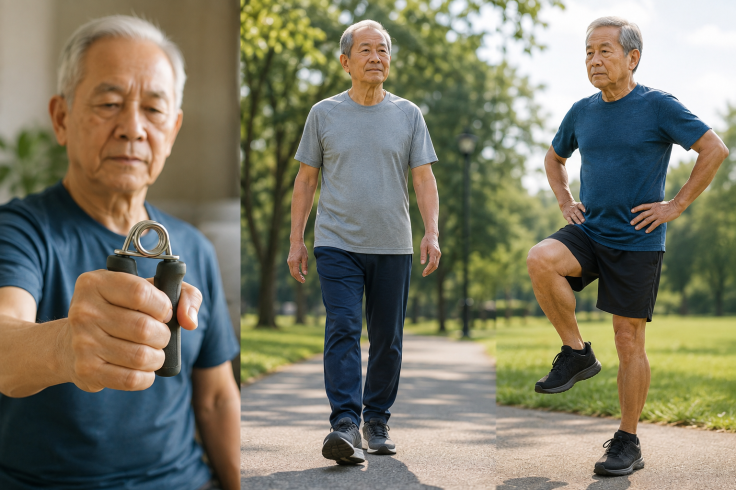
A weak grip, a slow walk and poor standing balance each predicted early death among 1,085 older adults in Japan, research in the Journal of the American Medical Directors Association found. Together, they predicted it more sharply still.
The group was tracked for a decade, and the link held for death from any cause and from heart disease, though not cancer. That helps explain why doctors watch how patients rise from a chair or cross a room.
Still, the tests are not a forecast of lifespan. A poor or declining result is a reason to investigate why function is changing, said Auriel Willette, a brain ageing expert at Rutgers University.
How the Three Tests Work
Walking speed is taken at a person's usual pace. Physical therapists at Orthopedic & Spine Therapy call it a whole-body signal because walking depends on the muscles, the heart and the nervous system.
Balance is judged by the single-leg stand, done with eyes open and hands on the hips. Timing starts as the foot leaves the floor and stops when it lands or the hands lift.
A hold of under 10 seconds can point to weakness in the nerves and muscles that keep a person upright, and a higher risk of falling. Grip strength, the third measure, is a rough proxy for whole-body strength.
Doctors use other checks too, including a floor test in which someone sits cross-legged, then rises. Researchers in Brazil, in studies from 2020 and 2025, found middle-aged people with higher scores were less likely to die within a decade.
Why One Score Is Not Enough
These are screening tools, useful for narrowing down a problem, whether knee pain, slow reflexes, poor balance or dizziness linked to the heart. They are not enough for a diagnosis.
Each test is meant to pinpoint a weakness and its cause, said Dr George Hennawi, who treats older adults at MedStar Health in Baltimore. The key, he said, is knowing where things went wrong.
Grip strength predicts many things, yet arthritis, stroke or untrained muscles can drag it down. It is one measure of many, said Dr David Lee of the Multidisciplinary Falls Clinic at UCLA.
A review in the journal BMC Geriatrics found 69 balance tests and 51 strength tests in use, carried out and reported in different ways. Few have been properly assessed in adults aged 60 to 70.
Falls, Frailty and Everyday Habits
Many doctors use these checks to judge frailty, a medical condition in which the body is less able to handle strain from illness or injury. Weak grip also helps flag sarcopenia, the muscle loss that comes with age.
All three measures respond to training. The physical therapists point to balance work such as yoga or tai chi, resistance training, dead hangs for the hands and regular walking.
Emily Nabors, a falls prevention expert at the National Council on Aging, cited one estimate that more than a quarter of older adults fall each year. Most never tell a doctor, she said.
That silence matters because a fall can be the first sign of a wider problem. 'If you've fallen, you might feel fine, but you might not be fine at all,' she said.
Anyone who scores poorly, or who has fallen recently, should raise it with a doctor. The result may point to physiotherapy, an assistive device or a change in medication.
Experts also warn against training simply to pass a test. Whole-body exercise, good meals, good sleep, less stress and heart care matter far more than one score.
Frequently Asked Questions
- What are the three predictive health tests for older adults?The three tests are grip strength, walking speed, and balance assessment.
- Why are these tests important?They help predict health risks such as frailty, sarcopenia, and potential falls in older adults.
- Can these tests diagnose specific conditions?No, they are screening tools that help identify potential issues but are not diagnostic on their own.
- What should be done if someone scores poorly on these tests?Consult a doctor to discuss the results, which may lead to recommendations for physiotherapy, assistive devices, or medication adjustments.