
Lindsey Vonn Reveals 5-Hour Surgery as Doctors Use Power Drills To Remove Screws From Her Broken Leg
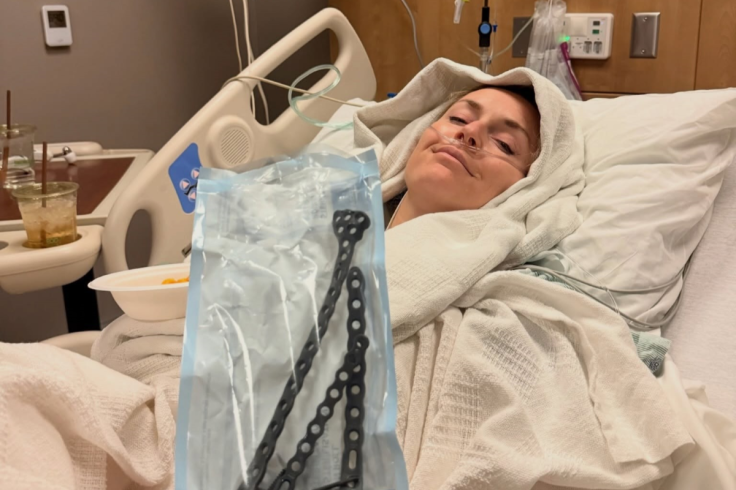
Lindsey Vonn has given fans a graphic look inside her latest operation, revealing how surgeons used power tools to remove metal plates and screws from her broken leg during a five-hour procedure.
The 42-year-old Olympic skiing champion shared footage of the operation on Instagram Stories on Sunday, 15 November, four days after undergoing her ninth surgery following a devastating crash at the 2026 Winter Olympics.
The video showed doctors using a power drill to remove screws securing metal plates in her left leg, with her surgical wound visibly opened during the procedure. Vonn captioned the footage, 'What power tools are made for', while including warnings about its graphic content.
The operation involved removing the hardware used to stabilise her complex tibia fracture and reconstructing her anterior cruciate ligament (ACL), which she had completely ruptured before the Olympic Games.
Vonn later confirmed that the procedure had gone well, saying it took more than five hours to remove the plates and screws and replace her ACL. She also revealed that she had returned home from hospital and was beginning another lengthy recovery.
How Lindsey Vonn's Olympic Crash Led to Nine Surgeries
Vonn's latest operation followed two serious injuries to her left leg within weeks of each other.
On 30 January 2026, she completely ruptured her ACL in a crash during a World Cup downhill event in Crans-Montana, Switzerland, nine days before the Winter Olympics. Despite the injury, she decided to compete in the women's downhill event on 8 February.
However, her Olympic campaign ended in a devastating crash after her ski pole caught a course flag, sending her off balance during her run. She suffered a complex fracture of her left tibia and was airlifted to hospital in Italy, where she underwent four operations, mainly to treat compartment syndrome.
She was subsequently transferred to the United States for further treatment, including additional procedures to repair the extensive damage.
The latest surgery was particularly important because the metal plates previously used to stabilise her fractured tibia had prevented surgeons from reconstructing her ACL.
Vonn explained that she had waited approximately nine months for the bone to heal sufficiently before undergoing the procedure.
Why ACL Injuries Can Require Months of Recovery
The ACL is one of four major ligaments in the knee, connecting the thighbone (femur) to the shinbone (tibia). It helps stabilise the joint and prevents excessive forward movement of the shinbone during activities involving sudden changes of direction.
A complete ACL rupture can cause significant knee instability, particularly during running, jumping and pivoting movements. Reconstruction typically involves replacing the damaged ligament with a tendon graft, followed by rehabilitation to restore strength, stability and mobility.
Vonn's recovery is complicated by the fact that she also sustained a severe tibia fracture. Unlike an isolated ligament injury, her treatment required surgeons to address both the damaged bone and the torn ligament.
Removing the metal screws has also left holes in the bone that must heal, adding another consideration to her rehabilitation.
Vonn said she expects another six to nine months of recovery, similar to the timeline associated with a typical ACL operation. However, her previous fracture and extensive surgical treatment make her rehabilitation particularly demanding.
The skier, who has won 84 World Cup races and three Olympic medals, has remained open about the physical and emotional challenges of her recovery.
After her latest procedure, she expressed gratitude that the operation had gone well and said she was finally on the road towards a full recovery.
Her latest update also showed her in a wheelchair with her leg dressed, reinforcing that returning to normal mobility will take time.
For now, Vonn says she is approaching rehabilitation one step at a time.