
Why One ACL Tear Often Isn't the Last, According to Sports Medicine Experts
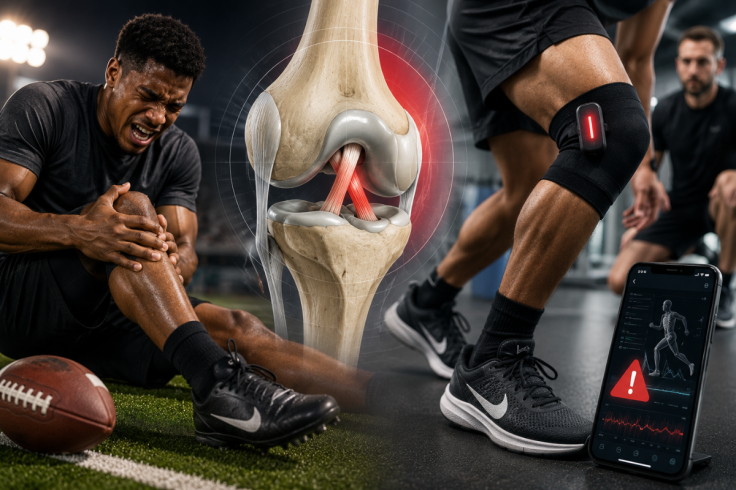
A repeat tear is common among those who have already torn an anterior cruciate ligament, according to Dr Nathan Schilaty, an associate professor in neurosurgery and medical engineering.
For plenty of athletes, the first ACL injury is a beginning, not an ending. Jaden Alexis is one of them.
The college wide receiver tore the ligament three times. He told Medical Xpress the first one sounded like an explosion.
What the Ligament Does
Four ligaments hold the knee together as a hinge, according to clinical guidance on knee injuries. Two of them sit deep inside the joint, crossing one another.
The anterior cruciate ligament, or ACL, is one of that pair. It runs between the thigh bone and the shin bone.
Its job is to stop the shin travelling too far forward on the thigh. Some travel is needed for the knee to work at all.
Too much travel can damage other parts of the joint. That guidance says the result is long-term problems for some patients.
Why the Second One Comes
Most tears come from a sudden pivot or change of direction in sport. They are commonly seen in basketball, football and American football.
Nearly 75 to 80 per cent of tears happen with nobody else involved, according to Schilaty. Stopping too suddenly, landing badly or turning awkwardly can do it.
That is the uncomfortable part for anyone coming back from surgery. The movement that did the damage was their own.
A torn ACL rarely travels alone. That guidance says the cartilage and the ligaments running down either side of the joint are often hurt at the same time.
Nor does the next one necessarily strike the repaired knee. Alexis tore his left ACL after recovering from the right, then partly tore that same joint the year after.
Recovery runs to roughly a year, and the toll is not only physical. 'It's a lot of having to regain trust in yourself, in your body and in your knee,' Alexis said.
How the Damage Is Graded
Injuries are sorted into three grades. A grade one ligament is stretched but still holds the joint steady.
A grade two is stretched and partly torn. A grade three has torn through completely, leaving no support at all.
Mild damage is usually handled with bracing, physiotherapy and a slow return to sport. Surgery may be recommended for a complete tear.
Spotting Risk Before It Strikes
Schilaty is working with John Templeton, an assistant professor in artificial intelligence and computing. The pair are building a wearable device that picks up dangerous movement and warns the athlete on the spot.
Ten years of work sits behind it. It covers human motion, experiments on donated knees and computer models.
Machine learning, software that reads patterns across many measurements at once, was set on the data. The models proved highly accurate at distinguishing the moments before a rupture from the rupture itself.
'It's able to identify and pick up patterns that we would not necessarily think of on our own,' Templeton said. The work points to which sensors a future device will need.
The pair picture a sleeve or set of sensors that spots the danger and buzzes the wearer. A player could then correct the fault without constant supervision from a trainer.
Neither man is promising to see an injury coming. The aim is to find the movements that raise the odds. 'What we do know is what's risky,' Schilaty said.
Frequently Asked Questions
- What is an ACL injury?An ACL injury involves a tear or sprain of the anterior cruciate ligament in the knee.
- How can ACL injuries be prevented?Prevention can include proper training, using wearable devices to monitor movements, and avoiding risky movements.
- What are the grades of ACL injuries?ACL injuries are graded from one to three, with grade one being a stretch, grade two a partial tear, and grade three a complete tear.
- What is the recovery time for an ACL injury?Recovery can take roughly a year, depending on the severity of the injury and the treatment approach.